.png)
Simple Past Tense
This tense is used to show a completed action that took place at a specific time in the past.
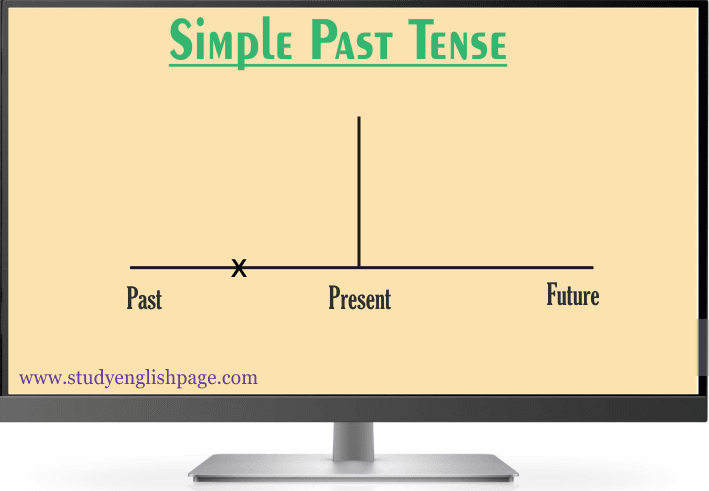
Ex:
·
He called his father last night.
·
They visited Iran last month.
It is also defined to show an action that was started and terminated in the past at a specific time. It is not important to mention the specific time; it should be in mind, or there should be an answer in mind for “when”.
Examples:
·
Last year, I didn't travel to Korea.
·
She washed her car.
·
He succeeded due to hard work.
·
I broke this cup.
·
The train arrived on time.
·
The match ended in a draw.
·
He had a narrow escape.
We use the simple past tense to show the duration of an action that
starts and stops in the past. The duration is a longer action which can be
indicated by expressions such as: for two years, for five minutes, all day, all
year, etc.

Examples:
·
I lived in Brazil for two years.
·
Shauna studied Japanese for five years.
·
They sat at the beach all day.
·
They did not stay at the party until the end.
·
They talked on the phone for fifty minutes.
·
A: How long did you wait there for us?
B: We waited for one hour.
Simple Past Forms
The past form of the verb is used in the Simple Past Tense. To
make a negative sentence, we use "did not". In questions, we use the auxiliary (did)
at the beginning of the sentence.
When we have NOT after DID in a sentence, we can write it in
short form.
Did not = didn’t
Affirmative:
Subject + verb (past form) + . . . . . . . . .
·
I began to study for my test a month ago.
·
Our dog bit my brother yesterday.
·
Ali broke the ice in the debate.
Negative:
Subject + did + not + verb (present form) + . . . . .
. . . .
·
Ali did not catch the ball.
·
He did not come first in the last exam.
·
Ali did not break the ice in the debate.
Interrogative:
Did + subject + verb (present form +……………….
·
Did you call Ali?
·
Did he study for his test?
·
Did he come first in the last exam?
Negative and Interrogative:
Did + not + subject + verb (present form) + . . .
. . . . . .
·
Didn't she guide you?
·
Didn't they study for their test?
·
Didn't he come first in the last exam?
Did + subject + not + verb (present form) + . . . . . .
. . .
·
Did she not guide you?
·
Did they not study for their test?
·
Did he not come first in the last exam?
When Clauses in Simple Past Tense
1. When-clauses are important because they always happen
first when both clauses are in the simple past.
1. When
I reached home, I called you.
2. I
reached home when I called you.
In sentence (1), I first reached home, and then I called
you. In sentence (2), I first called you, and then I reached home.
2. It is not important whether the “When Clause” is at the
beginning of the sentence or at the end of the sentence. If it comes at the
beginning, a comma is followed.
1. When
I reached home, I called you.
2. I
called you when I reached home.
The above sentences have the same meaning.
Yes/No Questions and Short Answers
A question that is answered by Yes or No is called a Yes/No
Question.
A short answer means to use just the subject and auxiliary after
yes or no to give an answer. A comma is used after Yes or No.
Ex:
·
Did you call Ali?
Yes, I did.
·
Did he study for his test?
No, I did not.
Information Questions (wh questions) and Answers
A question that is asked to interrogate or get information
is called an information question.
Ex:
·
What did you do last night?
·
Where did you meet him?
·
Why did you call him at midnight?
·
Who did you call?
·
Whose car did you drive to go to Lahore?
·
Which book did they buy yesterday?
·
How did he study in New York?
How to get the Past or ED form?
1) The general rule when changing a word (or verb) into its
-ED form is just to add -ED to the end of it.
|
Present form |
Past or ED form |
|
Play |
played |
|
Wait |
waited |
|
Work |
worked |
|
Rain |
rained |
·
They played football in the stadium.
·
I waited for them to invite me.
·
She worked until late last night.
·
It rained all day.
2) If a word ends in an E, we just add the D to the end.
|
Present form |
ED form |
|
Live |
lived |
|
Love |
loved |
|
Smile |
smiled |
|
Dance |
danced |
·
He lived in New York for two years and
then moved to Thailand.
·
I loved the surprise you gave me.
·
He smiled when he saw his son.
· They danced until their feet hurt.
3) When the verb ends in a VOWEL + Y, we add ED to the verb.
Present form | ED form |
Play | played |
Enjoy | enjoyed |
Survey | surveyed |
Deploy | deploy |
- We played cricket for three hours.
- I went to my friend's marriage party, so I enjoyed it a lot.
- The Board of Examinations delayed the final exam.
- Govt deployed its army near the border.
4) When the verb ends in a CONSONANT + Y, we change Y to I and add ED to the verb.
Present form | ED form |
Cry | cried |
Certify | certified |
Copy | copied |
Verify | verified |
- Some of the children cried in the class at first.
- I certified my documents from the university.
- They copied all of my documents.
- At first, she verified her ticket and then went to the airport.
5) If the word ends in a Consonant + Vowel + Consonant, we
double the final consonant and add ED.
|
Present form |
ED form |
|
Stop |
stopped |
|
Admit |
admitted |
|
Plan |
planned |
|
Refer |
referred |
|
Commit |
committed |
·
The policeman stopped the thief from escaping.
·
He admitted that he was wrong.
·
We planned a party for our friend.
·
I referred the students to the website where they
had online exercises for practice.
·
They committed a serious crime and will go to
jail.
6) BUT, we DO NOT double the final consonant when the word ends in W, X, or Y.
Present form | ED form |
Fix | fixed |
Enjoy | enjoyed |
Snow | snowed |
· He fixed his bike.
· We enjoyed our time in the mountains yesterday.
· It snowed yesterday.
7) If a two-syllable verb ends in a Consonant + Vowel + Consonant, we don’t double the final consonant when the stress is on the first syllable.
Present form | ED form |
Happen | happened |
Enter | entered |
Offer | offered |
Suffer | suffered |
· What happened?
· I entered through the back door.
· They offered me a new position with a higher salary.
· Coronavirus suffered many businesses all over the world.
8) When the verb ends in consonant + vowel + L, we double
the final L and add ED.
Note: In the United States, they don’t double the L when the
accent is on the first syllable.
|
Present form |
ED form |
ED form |
|
Travel |
travelled |
traveled |
|
Marvel |
marvelled |
marveled |
·
I traveled around South America in 2012.
·
Her beauty marveled us.