Posts

Showing posts from February, 2022

What are command sentences
Image
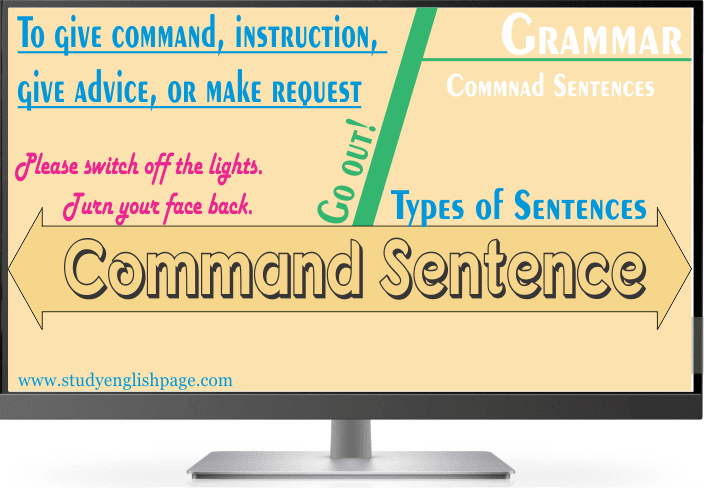
What are Command Sentences Command Sentences A command sentence is a sentence that is used to give a command, give instructions, make a request, or give a piece of advice. More obviously, a command is used to tell someone to do something. Who is someone? Someone is the second person to whom a command is given. Something includes a piece of instructions, a piece of advice, a piece of authoritative directions, or an instance of asking. Go out. Handle these fragile things with care. Respect others and you will be respected. Give her two hundred dollars to buy something, please. Form of Command Sentence When we form a command sentence, we focus on three main elements that help in constructing a command sentence. Elements of a Command Sentence Implied Subject (You) A command sentence looks as if it does not have a subject. An implied subject (You) is there, but we don’t use it. It is also called an understood subject. Everyone knows what the subject of a command sentence is...
A Declarative Sentence

Image
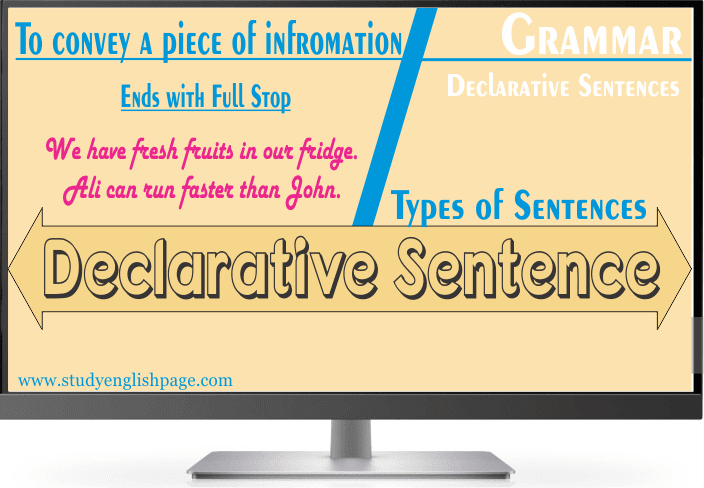
A Declarative Sentence Review of Sentence We use words to put thought into speech or writing. A group of words that is a complete thought put into words is called a sentence. We are learning declarative sentences. She works as a manager at Mobilink. Functionally, there are four types of sentences: declarative sentences, questions, commands, and exclamations. The most common type is a declarative sentence which is discussed in this content. The remaining types are available on the site Study EnglishPage . What Is a Declarative Sentence? A declarative sentence is used to convey a piece of information, state a fact, or make a statement. It always ends with a period or full stop. A declarative sentence needs at least a subject and a predicate that make up an independent clause. Ali can run faster than John. They don’t trust what we suggest to them. Examples of Declarative Sentences I have a laptop. Ali is from Pakistan. We have fresh fruits in the refrigerator. She a...

Past Participles in English

Image
Past Participles in English Meaning of Participles Participle means a word that is derived from the base form of a verb having characteristics of an adjective and verb. Definition of Participles A participle is defined as a word that is derived from the root form of a verb and functions as an adjective or to form verb tense. In other words, the ‘ing’ or ‘3rd’ form of a verb  that functions as an adjective or a verb is called a participle. There are two types of participles: present participle and past participle. Perfect participle is also considered a type of participle according to some sources. In this article, we are going to discuss Past Participles in English. You can visit our site Study English Page to study Present Participles. Past Participles in English The past participle is the form of a verb that is used in forming verb tense or used as an adjective. This form of the verb is also called the ‘ed’ form or 3 rd form of the verb that can be used in perfect ...

Present Participle in English

Image
Present Participle in English Meaning of Participles Participle means a word that is derived from a verb and has characteristics of an adjective and verb. Definition of Participles A participle is defined as a verbal that is derived from the root form of a verb and can be used as an adjective as well as to construct verb tense. In other words, we can define participle as the ‘ing’ or ‘ed’ form of a verb functioning as an adjective or a verb. There are two types of participles: present participle and past participle. Some sources also include a third type, perfect participle. Present participle in English is discussed in this article. You can study Past Participles on our site Study English Page . Present Participle in English A present participle is the form of a verb that ends in ‘ing’ and functions as an adjective or to form verb tense. In simple words, we can say that the present participle is the ‘ing’ form of a verb which is used as an adjective or in continuous tense...