
Compound Complex Sentences
Compound Complex Sentences
Sentence
‘What
is a sentence?’ is a question that must be clear before studying compound-complex sentences. A sentence is a group of words under the condition that expresses a complete thought. A complete thought can be in the form of a statement,
a question, a command, or an exclamation.
- I translate English into Urdu. (Sentence)
- Translating English into Urdu. (Not a sentence)
The
first group of words gives a complete thought, so it is a sentence. On the other
hand, the second group of words does not give a complete thought, so it is not a
sentence.
Our
main topic to discuss here is compound-complex sentences in English Grammar. It
is one of the four types of sentences according to the structure. You can study the
remaining three types on Study English Page.
Definition of a Compound-Complex Sentence
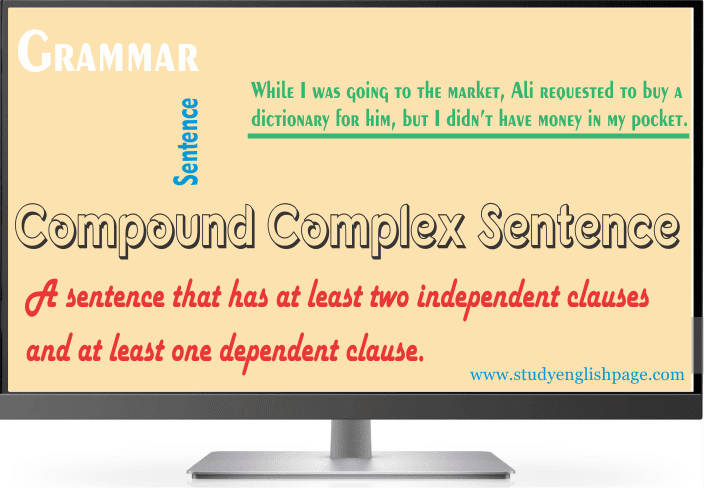
A
sentence that has at least two independent clauses and at least one dependent
clause is called a compound-complex sentence. A compound-complex sentence is a combination of a compound sentence and a complex sentence. Two independent
clauses are taken from a compound sentence, and at least one dependent clause is
taken from a complex sentence.
Three
main terminologies are used in these sentences. One of them is a clause. The definition
of a clause is a group of words that has at least a subject and a predicate.
The second one is the independent clause. It is a clause that gives a sense without
depending on anything else. The third one is the dependent clause. A clause that
can’t stand alone and depends on another clause to give a complete sense.
- When it rained, the weather became romantic, so we went out.
In this example, we have three clauses. The first one is the dependent clause. It does not give a complete sense if it is used alone. In this example, it gives more information to the sentence. The last ones are independent clauses.
More Examples of Compound Complex Sentences
- I called her, but she did not answer when you told me to call her.
- I was eating, and my Mom was cooking when the guests arrived.
- Come soon, and I will be waiting for you there by the time you come.
- She tries her best to meet me, but I do not want to meet her until you allow me.
- I have come to the supermarket so I can bring something if you want.
- Although it was snowing, they decided to go on a picnic, but I rejected it.
- I wanted to lose weight when I was in New York, yet I ate more fat.
- She amazed everyone because she danced beautifully, but she sang awfully.
- When I prepare a lecture, I visit the site (Study English Page), and I also study some other books.
- He achieved his life goal: he started his own business although I warned him not to start now.
Formation of Compound Complex Sentences
Formation
of compound-complex sentences is quite easy. It just links clauses. To join a dependent clause with an independent clause, you need to use a subordinate
conjunction. Independent clauses are joined with coordinating conjunctions,
correlative conjunctions, conjunctive adverbs, or appropriate punctuation
marks. The place of the dependent clause can be the beginning, middle, or end.
- While I was going to the market, Ali requested to buy a dictionary for him, but I did not have money in my pocket.
- I will get my promotion by chance; our company has terminated more employees because they demanded high salaries.
- I was busy when she called; therefore, I did not answer her call.
Key Points
At least two independent clauses
A compound-complex sentence must have more than one independent clause. A sentence with
one independent clause can’t be a compound-complex.
Though I am very busy these days, I give time to my children because it is necessary to give them time.
Using comma
The use of a comma has great importance in compound-complex sentences. When a dependent
clause is used earlier, it is also followed by a comma. When we join two
independent clauses, we use a comma before conjunctions. Remember that you can
also use a colon or semicolon in some cases.
When
I was twenty years old, I wanted to marry her; however, my parents discouraged
me.
Now Test Your Understanding
Related Links:
Join the conversation