Posts

Showing posts from August, 2023

Had Been vs Was

Image
Had Been vs Was When we compare the two things “had been and was”, we try to know their uses. Once you know the uses, their picture will become vivid. Some terminologies have been used in their uses. If you get any confusion, you can study them at the end. Uses of Had Been Had Been as an Auxiliary Verb We use had been as the auxiliary verb in constructing pastperfect continuous tense . The structure of past perfect continuous tense is subject + auxiliary verb + verb + …… Had been is used as the auxiliary verb. I had been waiting for John for 30 minutes by the time I left. They had been watching the movie for an hour when I met them. We can also use had been as the auxiliary verb in past perfect tense when our sentence is in passive voice. The patient had been examined before you reached the hospital. He had been transferred by the time I became known. Had Been in Past Perfect Tense This phrase is made of two words “had and been”. When we separate them, we term them...
Use of Had

Image
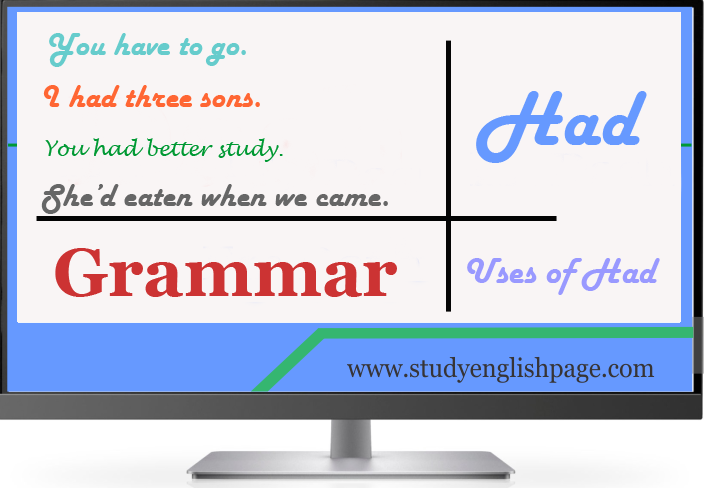
Use of Had   You may have seen the word “had” in different places. You may have got confused. After reading this article, you will understand different uses of “had”. Here are some examples. You had better read these examples before you dwell in details. I had three pens yesterday. They had better continue their work. I have had dinner with my friend so far. Lisa said that she had resigned from the job. I had received the appointment by the time you gave the offer. If she had invited me to the party, I would have attended the party. Uses of Had Had as an Auxiliary Verb The word “had” is used as an auxiliary verb to construct verb tense. We have different auxiliaries that we use in constructing verb tenses and other structures. We use “had” as an auxiliary verb in past perfect tense and past perfect progressive tense . They had left by the time she came. We had decided when you got informed. She had made tea before I ordered her. They had been waiting for two hours by ...

Examples of Coordinating Conjunctions

Image
Examples of Coordinating Conjunctions What are coordinating conjunctions?   Conjunctions are connecting words. These connecting words connect words, phrases, and clauses. There are more words that we use to connect words, phrases, and sentences. Some of them are coordinating conjunctions . If you want to study all types of conjunctions , you can visit our site Study English Page . Let’s have a brief overview of coordinating conjunctions. You may have noticed some words, phrases, or clauses that have equal importance. When we want to connect words, phrases, or clauses of equal importance, we use coordinating conjunctions. List of Coordinating Conjunctions It is very easy to remember because you need just one acronym (FANBOYS). There are seven letters in this acronym. Each stands for one word (coordinating conjunction). F = for A = and N = nor B = but O = or Y = yet S = so Useful Examples of Coordinating Conjunctions Examples of Coordinating Conjunction “For” John...

Indefinite Articles

Image
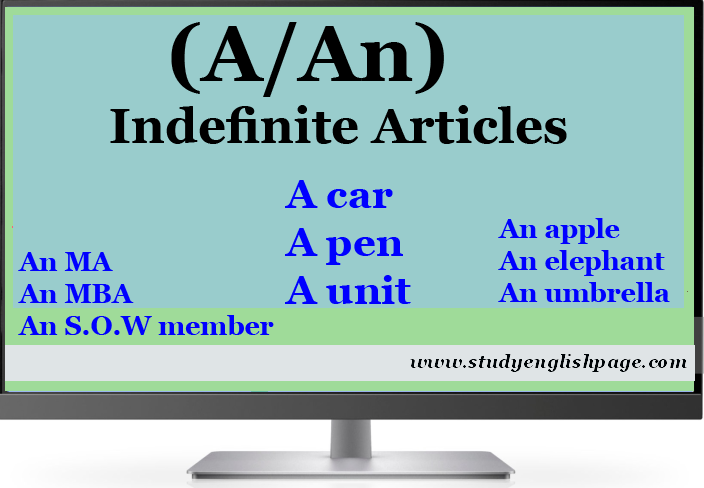
Indefinite Articles When you hear the word “article”, you may consider it like a news article. An article in English grammar is something completely different. In grammar, articles are words that we use before nouns or noun equivalents. They work as adjectives, or they are a type of adjectives. Definition of Indefinite Article Indefinite articles (a, an) are words that we use before singular countable nouns referring to unspecified nouns. There was a dog. In this example, the word “a” is an indefinite article. It has been used before the noun “dog” which is non-specific or something generic. We are talking about a general dog but not a specific dog. I met a man in New York. Here, the word “a” is an indefinite article that refers to something unspecific or mentioned for the first time in our discussion. Examples of Indefinite Articles Yesterday, we went to the zoo where we saw an elephant. He used to sit in a prominent place. When a person eats an apple a day, he will ...

Restrictive and Nonrestrictive Clauses

Image
Restrictive and Nonrestrictive Clauses Restrictive Clause A restrictive clause is a relative or adjective clause that provides essential information about the noun previously used in the sentence. The book that you took from the library is not available in the market. In this example, the restrictive clause is “that you took from the library”. If we take away the relative clause from the sentence, it will become as: The book is not available in the market. Both of the sentences are grammatically correct, but they are completely different based on their intent. The first example identifies the noun “book”. The information in the restrictive clause is essential but not additional. Formation of Restrictive Clause Restrictive clauses are created by using relative pronouns. Relative pronouns are not separated by commas from the nouns they identify when the relative pronouns create restrictive clauses. The person who was begging is not poor. I like the dog whose color is ...