Posts

Showing posts from September, 2023

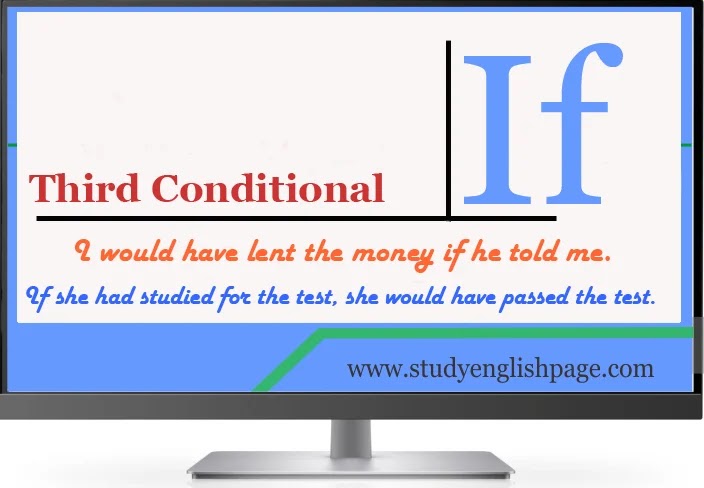
Third Conditional

Image
Third Conditional The grammatical structure “Conditionals” is an important topic that we must study because conditional sentences are used in our day-to-day lives. In this article, you will study the third conditional. If you want to study the other conditionals, you can also study by visiting Study English Page . What is the third conditional? The third conditional is a hypothetical or unreal condition that shows an event that did not happen in the past. The event could have happened under a certain condition. Consequently, the third conditional shows an untrue situation in the past. If I had studied hard for the test last year, I would have passed the test. This example explains that I had a test last year and I failed that test. The condition shows that the event did not happen in the past; therefore, I did not get the result of passing the test in the past. After the result, the situation was untrue. It did not have a possibility after taking the test, but before taking th...
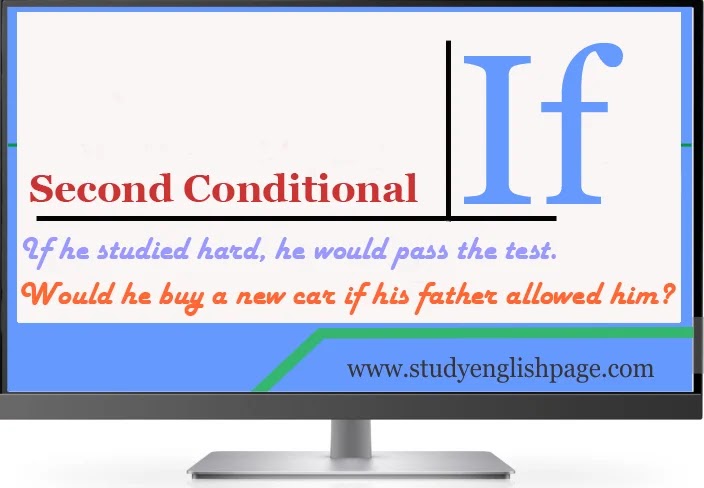
Second Conditional

Image
Second Conditional Conditional sentences have great importance in English grammar. In your life, you need to talk based on conditions. All conditional sentences are called conditionals. Conditionals include four types. One of them is the second conditional. What is the second conditional? The second conditional is a conditional sentence that we use for an event that does not have a possibility to occur in the present or future. In other words, the second conditional is a hypothetical condition that does not have a possibility to occur in the present or future. The second conditional shows unreal or untrue situations in the present or future. If I informed her on time, she would be present here now. This example means that neither the person informed nor the girl is present. He makes a hypothetical condition for her presence. Consequently, it shows an untrue situation in the present. How to form the second conditional? The second conditional consists of two clauses. One i...

First Conditional

Image
First Conditional What is the first conditional? A grammatical structure that we use to talk about an event that has a possibility to occur in the present or future is called the first conditional. It refers to a condition and its possible result. The first conditional is a conditional sentence that consists of two clauses. It consists of a conditional clause and a main clause. They are joined by the subordinate conjunctions if or when. The relation between the two clauses is cause and effect. When a certain condition is met, there is a possibility that you will get its result or outcome. If John studies hard, he will get 1 st position in his class. Look at the example. The first clause is the conditional clause. When this condition is met, there is a possibility that John will get 1 st position in his class. In other words, we can say that getting 1 st position will be the effect of John’s study. What are the examples of the first conditional? If I meet her, I will di...

Have vs Had

Image
Have vs Had When do we use have? Have is an Auxiliary Verb Have is an auxiliary verb. We use have as an auxiliary verb in present perfect, present perfect continuous, future perfect, and future perfect continuous tenses. We have joined a new company recently. They have been writing for two hours. I will have completed my homework by the time my father comes. We will have been discussing the issue for 10 minutes by the time they come. I want to bring you to one another important point. You may have seen the word “has”. We use the word “has” with similar meanings, but there is just one difference. We use the word “has” with third-person singular nouns or pronouns. It means we use has with third-person singular subjects and have with the others. In future tenses, we use have in both cases. Have is the Present Tense Form The word “have” is the present tense form of the verb “to have”. When we use have as a main verb, it shows possession, experience, activities that one perf...