
Present Continuous Tense
Present Continuous Tense
An action that is happening right now is called the Present Progressive Tense. An action that is going on at the time of speech.
Ex:
- I am writing a letter.
- He is doing his homework.
- They are reading a newspaper.
Graphical
Interpretation:
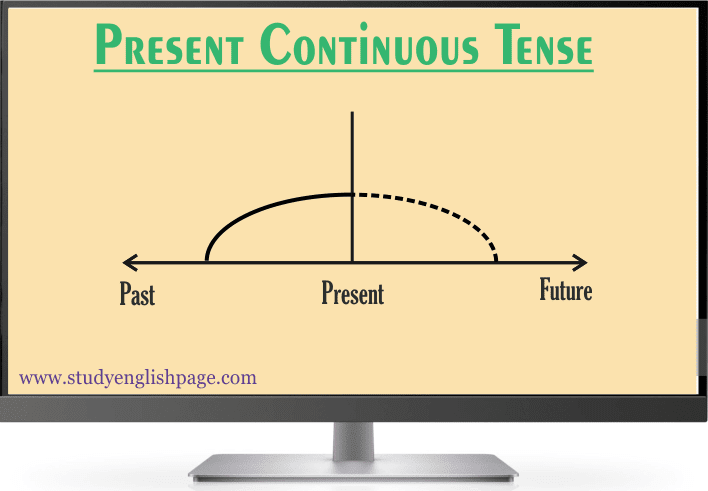
The present progressive tense shows an action that commenced in the past, is occurring right now, and will probably occur in the future. Examples:
- They are reading their books.
- They are watching television.
- She is becoming tired.
- I am doing my homework.
Present
Continuous Forms
Affirmative:
Subject + am/is/are + verb + ing + object…..
- You are watching TV.
- He is knocking at the door.
- I am doing my homework.
- They are attending the meeting.
Negative:
Subject + am/is/are + not + verb + ing + object….
- You are not watching TV.
- She is not peeling potatoes.
- I am not doing my homework now.
- They are not attending the meeting. They are discussing something else.
Interrogative:
Am/is/are +subject + verb + ing + object …..
- Are you watching TV?
- Is he leading a humiliating life?
- Am I going somewhere else?
- Are they attending the meeting?
Negative and Interrogative:
Am/is/are + not + subject + verb + ing +object …...
- Aren't you watching TV?
- Isn't he leading a humiliating life?
- Aren't I going somewhere else?
- Aren't they attending the meeting?
Am/is/are + subject + not + verb + ing + object…..
- Are you not watching TV?
- Is he not leading a humiliating life?
- Am I not going somewhere else?
- Are they not attending the meeting?
Yes/No Questions and Short Answers
A question that is answered by Yes or No is called a Yes/No
Question.
A short answer means to use just the subject and auxiliary after
yes or no to answer. A comma is used after Yes or No.
Ex:
- Are you writing?
Yes, I am.
- Is it raining?
No, it is not.
- Are they asking about me?
Yes, they are.
Information Questions (wh questions) and Answers
A question that is asked to interrogate or get information
is called an information question.
Ex:
- What are you doing?
I am cleaning the kitchen.
- Where is she studying?
She is studying in the garden.
- Why are they not answering?
Because they are not listening.
- Who is talking?
Ali is talking to his mother.
- Whose car is coming?
Ali’s car is coming.
- Which book is she studying?
She is studying an English Grammar Book.
- How is she listening?
She is listening attentively.
Contract forms or short forms
|
Short
form |
Short
form |
||
|
He is |
He’s |
He is
not |
He
isn’t |
|
She
is |
She’s |
She
is not |
She
isn’t |
|
It is |
It’s |
It is
not |
It
isn’t |
|
They
are |
They’re |
They
are not |
They
aren’t |
|
I am |
I’m |
I am
not |
I
ain’t |
|
We
are |
We’re |
We
are not |
We
aren’t |
|
You
are |
You’re |
You
are not |
You
aren’t |
|
Ali
is |
Ali’s |
Ali
is not |
Ali
isn’t |
- She’s becoming tired.
- I’m doing my homework.
- You’re watching TV.
- You aren’t watching TV.
- She isn’t peeling potatoes.
- I ain’t doing my homework now.
- They aren’t attending the meeting. They are discussing something else.
- Aren’t you watching TV?
- Isn’t he leading a humiliating life?
- Ain’t I going somewhere else?
- Aren’t they attending the meeting?
How to get the Ing-Form (Present Participle Form) of the verb?
1) The general rule when changing a verb into its -ING form
is just to add -ING to the end of the verb.
|
Feel |
feeling |
|
Go |
going |
|
Work |
working |
|
Sleep |
sleeping |
- She isn't feeling very well.
- He is working on a new project.
- The children are sleeping, so be quiet.
2) If the verb ends in an 'E', we remove the E and add ING.
|
Live |
living |
|
Have |
having |
|
Make |
making |
|
Take |
taking |
- We are making a chocolate cake.
- He is taking his time to get ready.
- We are living in the same room.
3) If the verb ends in a consonant + vowel + consonant, we
double the final consonant and add ING.
|
Stop |
stopping |
|
Sit |
sitting |
|
Plan |
planning |
|
Get |
getting |
|
Swim |
swimming |
- The policeman is stopping the traffic.
- We are planning a party for our high school teachers.
- I think I am getting a cold.
Fix | fixing |
Enjoy | enjoying |
Snow | snowing |
- He is fixing his bike.
- We are enjoying this great weather.
- It's snowing outside.
Happen | happening |
Enter | entering |
Offer | offering |
Suffer | suffering |
- What is happening?
- They are offering a discount.
- Many people are suffering from Coronavirus in the world.
6) If the verb ends in IE, we change it to Y and add ING.
|
Lie |
lying |
|
Die |
dying |
|
Tie |
tying |
- I know you are lying to me!
- You should water your plants twice a day because they are dying.
- The little boy is tying his shoelaces.
7). If the verb ends in consonant + vowel + L, we normally
double the final L and add ING.
Note: According to American English, we do not
double the L when the accent is on the first syllable.
|
ING form (UK) |
ING form (US |
|
|
Travel |
travelling |
traveling |
|
Marvel |
marvelling |
Marveling |
- I am travelling.
- He is marvelling at her beauty.
8) When a verb ends in a stressed vowel + R, we double the
final R and add ING.
|
Refer |
referring |
|
Defer |
deferring |
- Are you referring me to Dr. Asim?
- I am deferring my class.
9) When a verb ends in an unstressed vowel + R, we
do not double the final R and add ING.
|
Offer |
offering |
|
Suffer |
suffering |
|
Whisper |
whispering |
- I am offering you a special deal.
- He is now suffering from a fever.
- What is he whispering in her ear?
Join the conversation